Set the review boundary
This is a proposed workflow informed by official OpenAI Codex documentation accessed October 17, 2026; it is source-based guidance, not a report of a tested team rollout. Codex CLI documents dedicated local review against uncommitted changes, a commit, or a base branch without modifying the working tree. Its GitHub integration documents review requests and repository guidance. Those are two possible entry points for the process below.
Choose a small change with one purpose. Include the intended behavior, relevant constraints, and the exact diff or base branch. A reviewer cannot reliably infer whether a behavior is a regression without knowing the contract. Split a formatting rewrite away from a behavioral patch so the changed logic remains inspectable.
Prepare evidence before requesting review
- Write a brief change description with the user-visible behavior and the intended exception cases.
- Confirm the target branch and inspect the diff yourself, including configuration and dependency changes.
- Run the repository's relevant deterministic checks and retain the actual output.
- Identify sensitive boundaries: authorization, tenant isolation, data deletion, external requests, and migrations.
- Supply the reviewer with the nearby code and repository instructions needed to understand those boundaries.
For example, a pagination patch may look correct while dropping a tenant filter on subsequent requests. State the invariant explicitly: every page must apply the authenticated tenant restriction, regardless of supplied query parameters. Ask for analysis of both the new code and its call sites. Do not ask the reviewer merely whether the implementation looks good.
Ask for evidence, impact, and a reproduction
Use a prompt like this with the chosen local review surface. Adapt file names and requirements to your project:
Review the diff against the stated base branch.
Focus on introduced correctness and authorization regressions.
For each finding, give the file and location, triggering input,
expected behavior, actual code path, and user impact.
Explain the supporting evidence and any uncertainty.
Do not modify files. Do not claim tests ran unless you ran them.
If context is missing, name what is needed to check the concern.
The expected result is a short set of actionable hypotheses, each tied to changed behavior. An issue without a plausible trigger may still deserve investigation, but it should not automatically block a merge. Conversely, an empty review is only the absence of reported findings; it does not establish that every important path was examined.
Use the documented entry point deliberately
For local work, Codex CLI's dedicated review supports uncommitted changes, a commit, or a base branch. Select the scope that matches the patch you intend to merge. Check that generated files and earlier commits have not accidentally widened that scope.
For connected GitHub repositories with review enabled, OpenAI documents requesting a review using @codex review in a pull request comment. Setup and account access are prerequisites; posting the text alone does not configure the integration. Confirm repository settings and current access in the official documentation before adopting this route.
OpenAI also documents repository review rules in AGENTS.md. Use concise rules that explain consequential project constraints, such as tenant isolation or backward-compatible event payloads. Keep formatting rules in deterministic tooling. Official guidance explicitly says review rules do not replace tests, branch protections, or required approvals.
Verify findings before changing the patch
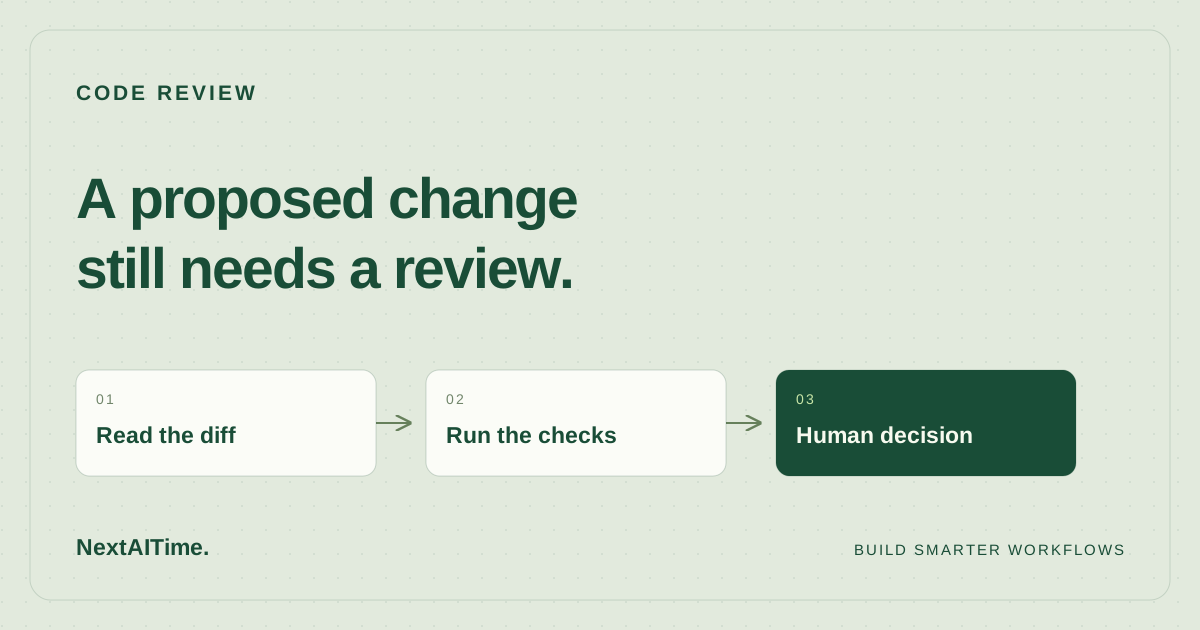
Assign a person to triage each material finding. Reopen the cited code, check whether the trigger is possible, and reproduce it with a focused test or a documented manual case. Mark it confirmed, disproven, or unresolved, with a reason. A confident description can still refer to an unreachable branch or misunderstand an existing safeguard.
If the pagination reviewer reports a missing tenant filter, inspect the complete request path before patching. The filter may be applied upstream; alternatively, the new branch may bypass that safeguard. Keep the regression check close to the actual boundary. Avoid adding a redundant condition solely to satisfy the generated review.
When a fix changes behavior, rerun the relevant checks and inspect the revised diff. Request another focused review if the correction introduces a new path or leaves the original question unresolved. Repeatedly asking for a clean verdict without investigating the evidence is not a useful completion criterion.
Leave a merge record another person can follow
- The intended behavior and exact review scope are recorded.
- Important findings have a disposition with supporting evidence.
- Relevant checks passed, or their limitations are explicitly accepted by the responsible reviewer.
- A person has inspected security-sensitive and irreversible behavior.
- The change has a practical rollback or recovery plan where needed.
Keep the record brief enough that teammates will read it. For a solo developer, make the same record before returning to the patch with fresh attention. For a team, the responsible human reviewer owns the merge decision under the existing repository policy.
Use the reliable AI workflow guide to define task boundaries, and the coding workflow comparison if you still need a tool. Review quality depends on explicit requirements and verified findings as well as the assistant you choose.
Sources & further reading
Primary references used for product and technical information. Features and terms can change; check the provider before committing.
- OpenAI Codex CLI documentationAccessed 2026-10-17
- OpenAI Codex code review for GitHubAccessed 2026-10-17