What this comparison establishes
This source-based comparison uses official documentation reviewed October 17, 2026. It compares documented workflow concepts and operating choices, not paid editions, execution allowances, prices, or measured performance. The recommendations are starting points for a trial, not rankings of ease of use or reliability.
For a small team, the most useful comparison starts with the same job. Use a synthetic inquiry submitted through a form, enrich it with a customer record, and prepare a follow-up draft for approval. Include a missing email, a duplicate submission, and an unavailable destination. A successful happy path alone will not reveal who owns recovery.
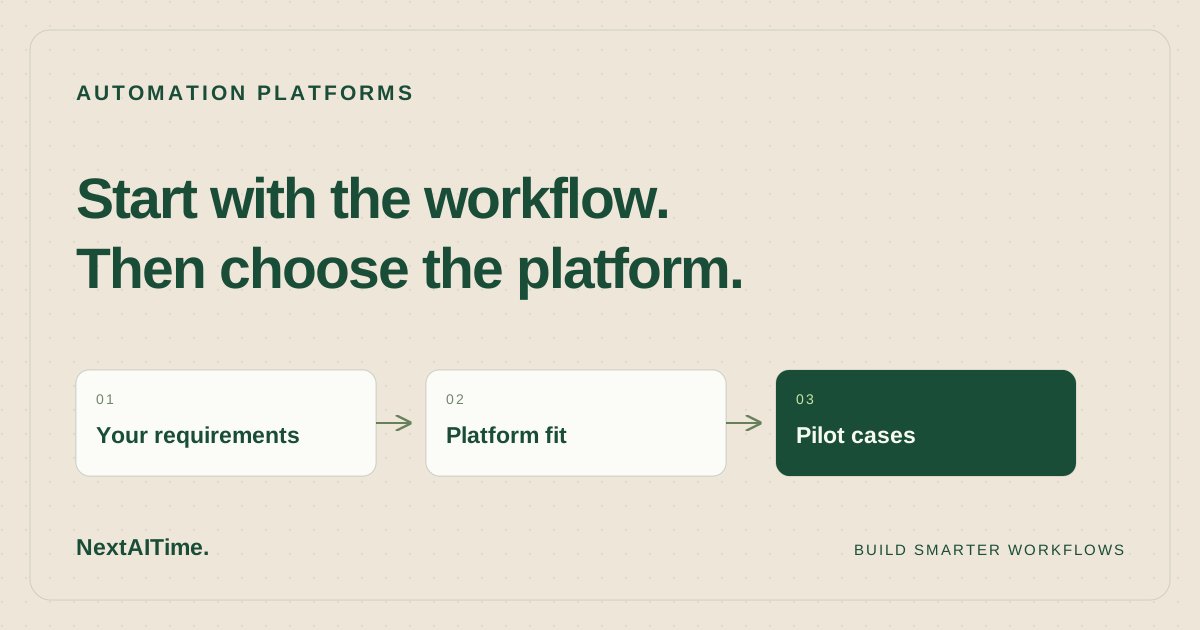
Match the documented model to your job
| Candidate | Documented starting point | Question for your pilot |
|---|---|---|
| Zapier | An event triggers a Zap, which runs its workflow actions. | Can the exact app event and required actions complete your process? |
| n8n | Visual workflows with custom code; cloud and self-hosted deployment options. | Does the control justify your development and operating effort? |
| Make | Current documentation covers scenario inputs and outputs; its hosted MCP server can run active and on-demand scenarios. | Do scenario boundaries, recovery controls, and any MCP access match your process? |
The Zapier trigger guide defines a trigger as the event that starts a Zap and explains that actions follow it. That maps naturally to a form-submission example. It does not prove your specific form connector exposes the fields, event timing, or actions you need; check those in the pilot.
Treat hosting as an ownership decision
The n8n repository explicitly describes self-hosted and cloud use, a visual canvas, and custom code. If your team has a requirement to run the automation service itself, that is a concrete reason to evaluate n8n. Its source-available licensing should also be reviewed for your intended use; do not equate accessible source code with unrestricted rights.
Self-hosting creates work beyond building workflows. Assign responsibility for upgrades, credentials, backups, restore checks, and incident response. For a solo founder, those duties compete with product work. A managed service can remove some infrastructure duties, but you still own workflow logic, permissions, data quality, and the business consequences of a mistaken action. Verify the actual deployment and contractual options for each shortlisted edition.
Evaluate Make for reusable scenario workflows
Make's current scenario documentation describes inputs and outputs for passing data, subscenarios for chaining workflows, and incomplete executions for storing failed runs and resolving them automatically or manually. Those are useful starting points when an inquiry-handling workflow must hand data to a reusable enrichment step. Check the detailed settings and your account before assuming every failure can be replayed safely.
If an AI assistant needs to call the workflow, Make's current MCP server documentation describes a Make-hosted cloud server connected through OAuth or an MCP token. It can expose tools to run active and on-demand scenarios. Available tools depend on selected scopes; scenario run tools are available on all plans, while management tools require paid plans. This distinction concerns MCP tool access, not unlimited usage or general pricing.
For a first pilot, expose only the scenario operations the assistant needs. Keep account-management permissions separate from executing the business workflow. Test inputs, outputs, and failure reporting through the exact connection you intend to use. A documented recovery feature does not establish that retries will avoid duplicate emails or customer records.
Run the same recovery exercise in every candidate
Create the smallest workflow that produces the approved follow-up draft, and write down every manual intervention. Submit the duplicate twice and check whether the destination receives one business action or two. Force an invalid address and inspect how the failure becomes visible. Restore the missing destination and determine whether recovery repeats already completed work.
Have a second teammate explain the workflow from its saved configuration. Record how long diagnosis takes, which permissions were required, and what must be maintained when an app field changes. These are proposed evaluation steps, not results we measured. For AI steps, treat generated text as untrusted until validated; see the reliable workflow guide.
Choose the service someone can own
Use three acceptance gates: the workflow performs the required action, failures can be recovered safely, and a named person can maintain it. Then estimate cost from the selected plan's actual billing units and your observed pilot activity, including retries. Do not infer equivalent bills from an identical number of workflows.
Choose Zapier if its event-and-action model passes those gates with acceptable effort. Choose n8n if its documented deployment or code options solve a concrete requirement and you can support the resulting setup. Choose Make when its scenario model and documented recovery or MCP integration options fit the process and pass those checks. Keep the pilot record so the next comparison begins with evidence instead of rebuilding the shortlist from scratch.
Sources & further reading
Primary references used for product and technical information. Features and terms can change; check the provider before committing.
- Zapier: Set up your Zap triggerAccessed 2026-10-17
- n8n official repositoryAccessed 2026-10-17
- Make: ScenariosAccessed 2026-10-17
- Make MCP ServerAccessed 2026-10-17