A storefront rollout makes browser tools more concrete
On October 21, 2026, Cloudflare described a WebMCP integration with Commerce.com across a platform serving almost 100,000 domains. That scale is Cloudflare’s reported platform footprint, not a count of shoppers using agents or proof of increased sales. The engineering detail is more useful than the headline: merchants can expose shopping tools while retaining an individual opt-out.
WebMCP gives an agent working in a browser structured actions instead of requiring it to infer every button from a page. Cloudflare’s example pairs product search with adding a selected item to a cart. The announcement describes an experimental proposed browser standard, not universal support across browsers or AI assistants.
For SaaS builders, this is a useful design signal. A tool interface can make a product’s actions explicit, but its value depends on the task and the agent environment. A small team should identify that task before adding another integration.
Browser tools and server-side MCP serve different entry points
The Commerce.com integration runs tools within the shopper’s active browser session on the storefront domain. Cloudflare says this lets the agent work with the same cart and prices visible to the shopper. The company also describes its edge bridge as proxying the merchant platform’s backend MCP tools and requests.
A server-side MCP connection serves another entry point: an assistant connecting directly to a service. The announcement says Commerce.com supports both approaches. Do not assume that installing an MCP server automatically gives every visitor a working WebMCP interface, or that adding browser tools makes a site discoverable in AI search.
Our local MCP workflow guide covers a separate, server-tool learning exercise. The shared idea is an explicit action contract. Authentication, session behavior, browser support, and the permitted action set still need to be assessed for each integration.
The useful platform feature is a merchant-level off switch
Commerce.com uses Cloudflare for SaaS across merchant vanity domains. A zone-wide switch alone would not let each merchant decide whether to participate. The integration combines Configuration Rules with custom hostname metadata so a merchant’s opt-out can bypass WebMCP injection for that storefront.
This is worth studying if your startup runs a multi-tenant product. A shared infrastructure setting can become a customer-facing product decision. Give each tenant an explicit participation state and verify that disabling it removes the intended interface. Do not use a global rollout as a substitute for checking tenant isolation.
The same announcement describes support for a configurable MCP endpoint because the merchant platform used /api/mcp rather than the bridge’s original /mcp assumption. Configuration details like this are part of the integration contract. Record the actual endpoint rather than copying an example into production unchanged.
Start with a narrow action and keep consequential decisions clear
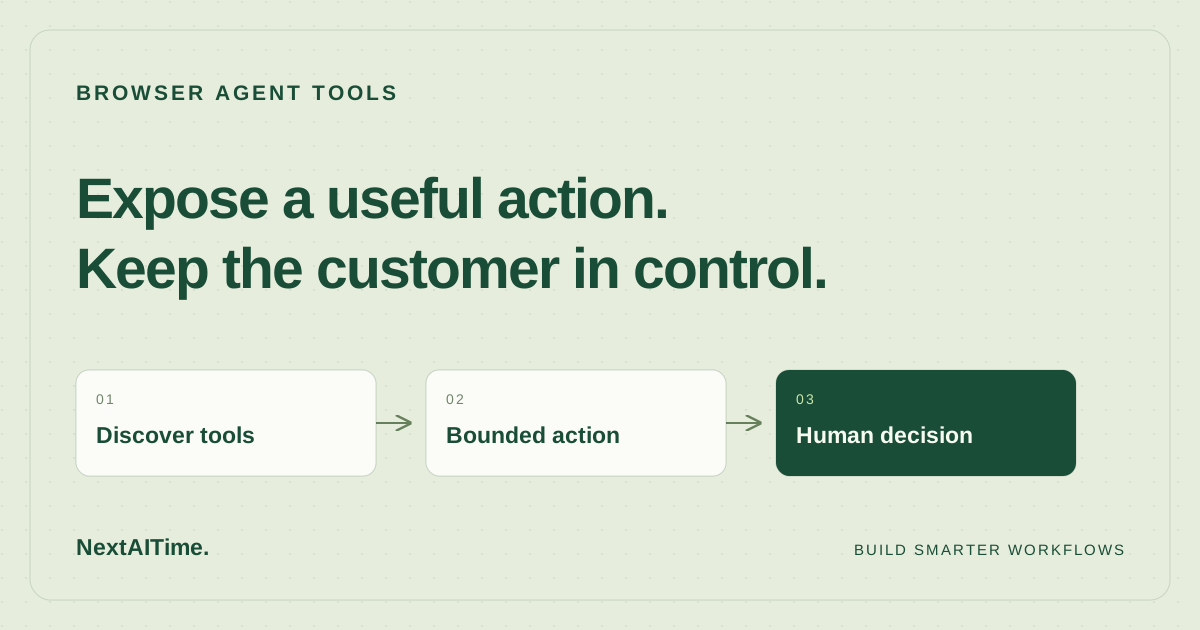
In Cloudflare’s shopping example, the agent searches and updates a cart, while the shopper clicks checkout to complete the purchase. That is the flow described for this integration; it is not a guarantee that every WebMCP implementation requires a person to approve every write.
A SaaS team could apply a similar boundary to a hypothetical scheduling product: expose available time slots and prepare a booking, then require a clear confirmation before committing it. That example is a proposed design, not a feature we tested or a claim about the Commerce.com tools.
Define what happens when the same request arrives twice and when the caller loses the response. A browser tool can still trigger a real backend write. Our local idempotency tutorial explains why a stable action identity helps, and why local database protection does not guarantee exactly-once remote execution.
A small pilot should test unsupported environments too
Cloudflare says the Commerce.com bridge exits when the browser lacks WebMCP support or the MCP server is unavailable, leaving the ordinary storefront experience intact. Treat that as documented behavior to verify in your own setup. We have not tested this bridge, merchant checkout, or any browser compatibility matrix.
For a pilot, choose one discoverable, narrowly scoped action. Check its input validation, session identity, and authorization rules. Then test an unsupported browser, an unavailable endpoint, an expired session, and a repeated call. Verify the human interface remains usable when the tool path fails.
Capture observable requests and outcomes without storing unnecessary personal information. Measure whether the intended task succeeds, what intervention it needs, and whether failures are understandable. Compare the same scenarios before and after a change using the approach in our agent evaluation guide. A tool appearing in a browser is only the first acceptance check.
Adopt for a specific workflow, not an indexing promise
WebMCP deserves a pilot when your customers already use compatible browser agents and your product has repeated actions that benefit from explicit tools. It is less urgent for a small informational site with no interactive workflow. Publishing accurate, accessible content and maintaining crawlable links remains a separate job.
The announcement establishes an integration pattern and reported deployment reach. It does not establish conversion uplift, traffic gains, lower token bills for your users, or availability in every account. Confirm the current product access and supported environments before planning a launch.
For a founder, the practical question is simple: which customer action becomes easier to complete, and can the customer still understand and control the outcome? If you cannot name that action, wait. If you can, a constrained experiment with an off switch is a more useful next step than exposing every application operation at once.
Sources & further reading
Primary references used for product and technical information. Features and terms can change; check the provider before committing.
- Cloudflare: How Commerce.com and Cloudflare are getting storefronts ready for AI agentsAccessed 2026-10-23
- Cloudflare: Give any website a WebMCP interfaceAccessed 2026-10-23