The news: model selection moves into the gateway
Cloudflare announced AI Gateway Auto Router in public beta on September 30, 2026. Applications send a request with cloudflare/auto as the model, and the gateway chooses from an eligible pool. For a small team with a mixture of simple extraction, drafting, and harder reasoning requests, this makes automatic model selection an infrastructure option worth evaluating.
The useful change is where the decision happens. Instead of asking every application feature or employee to choose a model, the gateway evaluates the request. That can reduce scattered routing logic, but it also makes the gateway's policy part of your product behavior. A successful integration therefore needs an explicit quality threshold and a way to explain which model handled a request.
Eligibility comes before the cost tradeoff
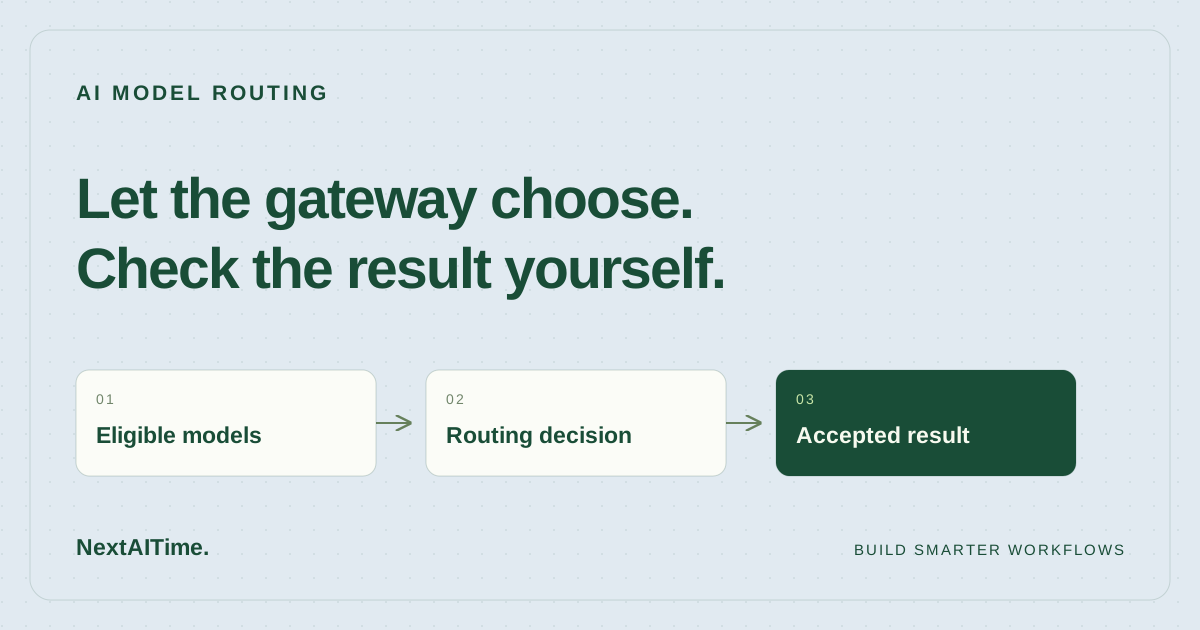
According to Cloudflare's documentation, Auto Router first excludes models that cannot handle a request's format or inputs. It also considers credentials, billing configuration, and gateway spend limits. Unhealthy providers are excluded until they recover. A classifier then estimates task type and difficulty, and a scoring step ranks eligible models by expected quality and cost.
That distinction matters for founders evaluating the feature. Routing cannot make an unavailable model available, supply missing credentials, or turn an incompatible model into a suitable destination. Start by deciding which providers and models your application can use, using the AI API evaluation checklist to define requirements. Then evaluate whether the router chooses well inside that boundary.
The documentation exposes cf-aig-allowed-models and cf-aig-allowed-providers for narrowing selection. If both are supplied, a model must match both. The allowed-models header replaces the default model set; an entry matching no model produces a 400 error. Treat these controls as configuration that needs validation before rollout.
A conversation needs a session identity
The most actionable integration detail is session affinity. Cloudflare documents cf-aig-session-id as the header that keeps the same model for a turn, including follow-up tool calls. Without a session ID, the router selects a model for each request, and requests in one conversation may land on different models and lose prompt-cache reuse.
At the start of a new turn, the router can switch when its expected benefit outweighs the cost of losing the cache. This is especially relevant to coding assistants and support agents, where one user task may generate many calls. Evaluating isolated prompts would miss the behavior that matters during a long conversation.
For a pilot, preserve a consistent session ID through the complete tool loop. Include both short tasks and conversations that grow substantially. Use the AI stack budgeting framework to measure the total cost and completion time of each finished task, including retries, rather than assuming a lower-priced model automatically creates a cheaper result.
Inspect routing decisions before expanding traffic
The response includes cf-aig-routed-model, cf-aig-routing-reason, and cf-aig-routing-decision-id. These let a team connect a result to its selected model and routing decision. The documented reason codes distinguish ordinary cost-quality selection, reuse within a turn, and cases where only one candidate was eligible.
They also distinguish fallbacks caused by provider unavailability, router errors, router timeouts, and unsupported inputs. A successful HTTP response alone therefore does not establish that the normal classifier-based selection happened. Track fallback reasons alongside errors, output acceptance, and latency.
A practical pilot should compare routed requests against your current fixed-model path on the same representative tasks. Keep task IDs, model choices, routing reasons, and pass/fail criteria together. Inspect failures individually: a cheaper response that requires a second attempt or manual rewriting may be a worse business outcome.
The launch evidence leaves room for a quality tradeoff
Cloudflare's announcement includes an internal knowledge-work benchmark with 97 tasks and three samples per model per task. Auto Router completed 252 of 291 trials successfully; one evaluated frontier model completed 281 of 291. Those vendor-reported results illustrate why an attractive cost figure does not establish equivalent reliability for your application.
This article does not independently reproduce that benchmark or test the service. The right inference is that automatic routing deserves a workload-specific evaluation, especially where a missed instruction or incorrect tool action costs more than the model call. A draft-writing assistant and an agent changing production settings should not share an acceptance threshold merely because both use chat messages.
There is also a freshness detail: the September 30 announcement listed fuller Responses API support among future work, while the documentation accessed October 21 states that Chat Completions and Responses API formats are supported. The same documentation says WebSockets are not yet supported. Use the current integration documentation when assessing compatibility.
Pilot it where task variety justifies the added policy
Auto Router is a sensible pilot for a team already using AI Gateway, serving varied tasks, and able to judge output quality consistently. Start with the boundaries in our reliable AI workflow guide: choose a bounded feature whose results can be reviewed, restrict the candidate pool, preserve session identity, and retain a fixed-model comparison. Decide in advance what quality regression, latency increase, or fallback rate would end the pilot.
Keep a fixed model when reproducibility, a narrowly approved provider, or a highly specialized workload makes automatic selection less useful. Cloudflare says its managed model pool can change over time. Record your configuration and review the eligible models periodically rather than treating today's behavior as a permanent contract.
Finally, do not read routing eligibility as proof of a data-retention policy. The launch post described incorporating zero-data-retention requirements into filtering as future work. Verify the current contractual and provider requirements separately before sending sensitive material. Adopt the router when your own accepted-result measurements justify it; the launch announcement supplies a hypothesis, not your production acceptance test.
Sources & further reading
Primary references used for product and technical information. Features and terms can change; check the provider before committing.
- Cloudflare: Cut your AI spend with AI Gateway’s Auto RouterAccessed 2026-10-21
- Cloudflare AI Gateway documentation: Auto RouterAccessed 2026-10-21