Google’s October 22 architecture gives agents changing authority
On October 22, 2026, Google published Architecting Governed, Self-Evolving AI Agents on Google Cloud. The accompanying Project Chrysalis reference implementation explores an incident-response agent that generates a mitigation tool, records lessons, and proposes changes to its own team of specialist agents. This is an architecture and demonstration, not evidence that unattended production repair is ready for your application.
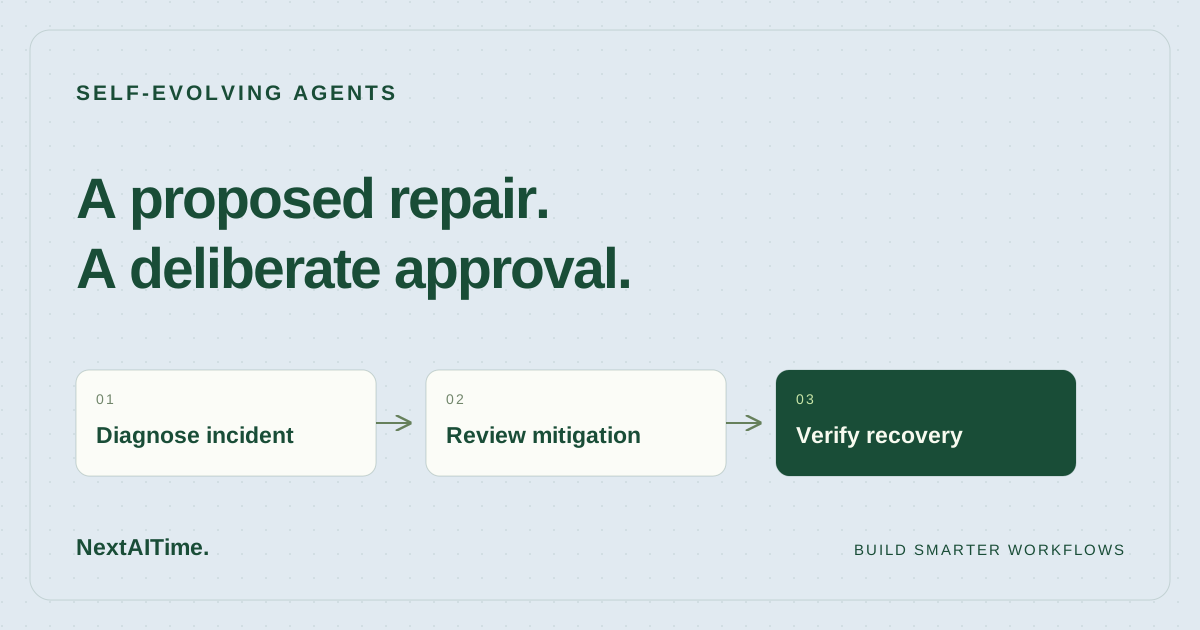
The useful change in emphasis is that an agent’s tools and organization can evolve during an incident. Google separates temporary hotpatching, remembered operational principles, and structural changes to the agent hierarchy. Its design places a human approval gate before the structural change.
For a small SaaS team, adopt the separation of authority first. Consider the full sample only if you have an engineer who can inspect its execution paths, cloud integrations, and fallback behavior.
The repository draws a narrower boundary than the headline
The official README distinguishes production targets from what the sample runs. The cache is a local LRU simulation; the database uses SQLite and a two-slot connection-pool semaphore. Its Model Armor-style shield uses local regular expressions, while its policy controller is described as OPA style. These distinctions matter when assessing the security and reliability of an installation.
The README describes real Cloud KMS signing and BigQuery replay when provisioned, with local fallbacks otherwise. It also documents deterministic fallbacks when cloud credentials are absent. A successful demonstration therefore does not establish that every named cloud service participated.
Before drawing conclusions from a pilot, record which integrations actually ran. Separate cloud-backed behavior from simulations and fallback responses. We reviewed the article and README on October 23; we did not install the sample, inspect every implementation file, or run its tests.
Zero server errors still leaves a customer outcome to measure
The blog’s simulated outage improves after the agent adds a token-bucket rate limiter. But the reported second burst serves 10 requests from warm cache and throttles 40 with HTTP 429. Its zero HTTP 500 result is a statement about server errors, not proof that all customers completed checkout.
Load shedding can be the right response to overload. The adoption question is whether your callers retry safely, whether they receive understandable feedback, and whether important requests can eventually succeed. Measure accepted requests, throttled requests, successful business operations, and time to recovery together.
One detail also needs resolution before copying parameters: the blog describes a minimum replenishment rate of 10 requests per second, then reports a replay winner at 5. Those figures do not establish that the winning replay policy is admissible under the stated guardrail. Treat replay output as a candidate requiring policy validation.
Give a small-team pilot less authority than the demonstration
Start with read-only diagnosis. In a hypothetical support SaaS pilot, the agent can inspect synthetic queue-depth and database-pool telemetry, explain a likely bottleneck, and propose a prewritten rate-limit change. An engineer approves execution. This is our suggested pilot design, not an outcome observed in Google’s example.
Prefer a small catalog of reviewed actions before permitting runtime code generation. Define allowed targets, parameter ranges, expiration, and reversal for each action. Keep permission to alter those boundaries outside the agent performing the repair. Our reliable workflow design guide helps identify the handoff between a recommendation and an authorized action.
Signing an artifact establishes provenance and integrity under the signing system; it does not prove that its behavior is correct. Likewise, syntax checks and input filters have specific coverage. Require observable acceptance checks for the action you would actually allow.
Make the first exercise about failure and recovery
Use a disposable environment with synthetic traffic and a clear baseline. Trigger one known overload condition, capture the recommendation, and have a human apply an approved mitigation. Record the telemetry before and after, including throttled traffic. Then remove the mitigation and verify restoration.
Repeat the exercise with a failed tool call, a duplicate alert, and a mitigation that finishes after its approval has expired. Define whether each case should stop, retry, or request review. Our bounded-retry guide explains why limiting retries also requires attention to elapsed time and operations already in progress.
If the action writes state, give repeated events a stable identifier and check the destination’s behavior. The idempotency guide provides a local example. Record cloud usage when available; this source review provides no measured operating-cost estimate.
Adopt the governance pattern; defer autonomous hotpatching
For a team already operating Google Cloud services, Chrysalis is worth studying as a reference for separate diagnostic, tuning, and structural permissions. A sandbox evaluation is reasonable when someone owns the cloud setup, incident metrics, and recovery procedure.
For a founder without that operational capacity, use an agent to summarize incidents and draft reviewed actions. Adding dynamic code generation, signing infrastructure, memory, and agent rewiring introduces more components to understand during an outage. The announcement alone does not demonstrate that this complexity improves your service.
Move beyond read-only use only after your own exercise shows that authorized actions preserve customer-facing requirements and can be reversed. Keep permanent changes under human review. Google’s new architecture supplies ideas to evaluate; your application’s recovery behavior supplies the adoption decision.
Sources & further reading
Primary references used for product and technical information. Features and terms can change; check the provider before committing.
- Google Developers Blog: Architecting Governed, Self-Evolving AI Agents on Google CloudAccessed 2026-10-23
- GoogleCloudPlatform generative-ai: Project Chrysalis READMEAccessed 2026-10-23